

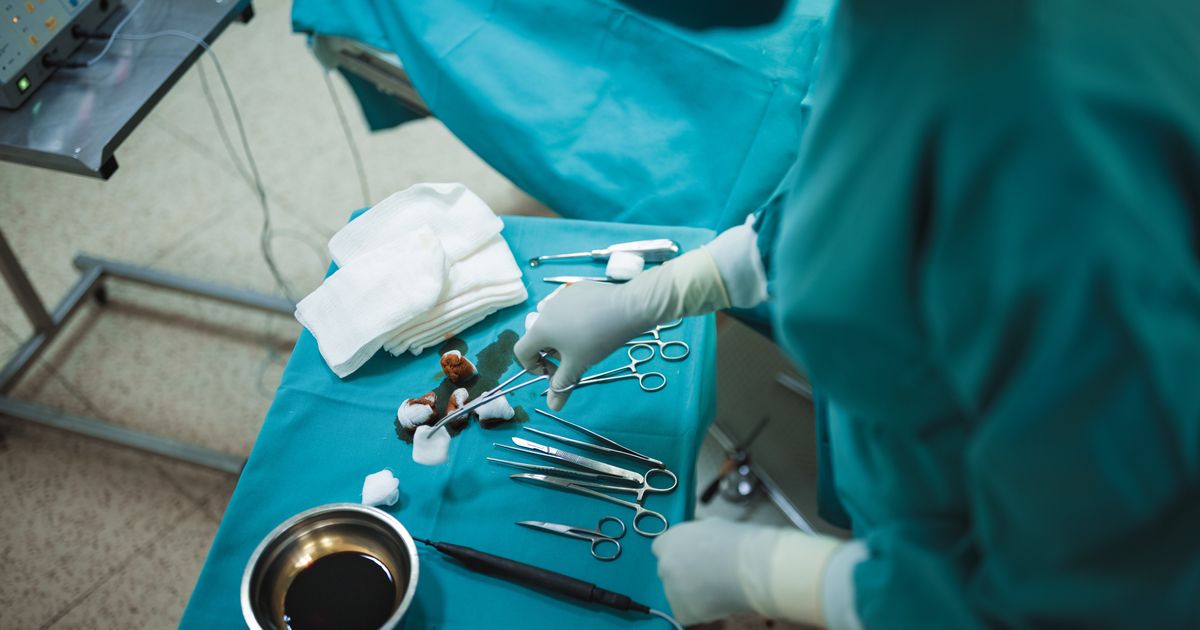
During operations or procedures last year, patients left behind gauze, swabs, and surgical devices including drill bits.
New hospital data shows that a record number have sought help after medical professionals left a surgical tool inside.
Errors involving “accidentally leaving a foreign body in the body during surgical and medical care” resulted in 291 “consultant-ended episodes” being recorded – ie. Additional support was required – in 2021/2022.
This was twenty years ago, when there were 156 episodes. Hospital data shows that there was only 138 episodes in 2003/04.
Last year, the average age of patients with foreign bodies in their bodies was 57. These errors have affected patients of all ages, from children to those over 90.
This is a file NHSUnder constant pressure, caring for more patients than ever before.
Most commonly found inside a patient are gauze and swabs used during surgery. However, in rare cases, surgical tools such as scalpels or puncture bits can also be found.
Hospitals have strict procedures in order to avoid such blunders. These include checklists and frequent counting surgical instruments.
NHS Digital data does NOT indicate when the patient received the initial surgery or treatment that led up to the accident. It does not even mention whether the procedure was performed within the NHS or in a private facility. Because some people have received care at more than one hospital, each episode may not be applicable to the same patient.
The NHS considers it ‘never to leave anything’ after surgery, meaning that the accident was too serious for anyone to have and should never have happened.
If a surgical instrument is left in a patient’s body, it may need to be removed again.
“Accidents are never called that because they are serious accidents that are completely preventable because the hospital or clinic has systems in place to prevent them from happening,” Rachel Bauer, chief executive of the Patients Association, told PA Media.
“When they happen, the severe physical and psychological effects they cause can last a patient’s entire life. This should never happen to anyone who seeks NHS treatment.”
Analysis by PA, Published May 2022From April 2021 to March 2022, around 407 ‘nevers’ were found on the NHS England. Patients were asked to provide vaginal swabs 32 times, and surgical swabs 21 times. While her ovaries were removed by mistake.
Some of the other items found inside the patients were a pair a wire cutters, a portion of a scalpel blade and screws from a pair surgical forceps.
A spokesperson for NHS said that such incidents are rare because of the hard work and dedication of NHS staff. The NHS is committed to learning from such incidents in order to improve the care of patients in the future.
The spokesperson said that the NHS had published new guidance in the past year. This represents a significant shift in how the NHS responds when it comes to patient safety incidents. This will allow organizations to increase their focus on understanding the causes of these incidents and make improvements.
Source link
[Denial of responsibility! wideworldmag.co.uk is an automatic aggregator of the all world’s media. In each content, the hyperlink to the primary source is specified. All trademarks belong to their rightful owners, all materials to their authors. If you are the owner of the content and do not want us to publish your materials, please contact us by email – at wideworldmag.co.uk The content will be deleted within 24 hours.]
