

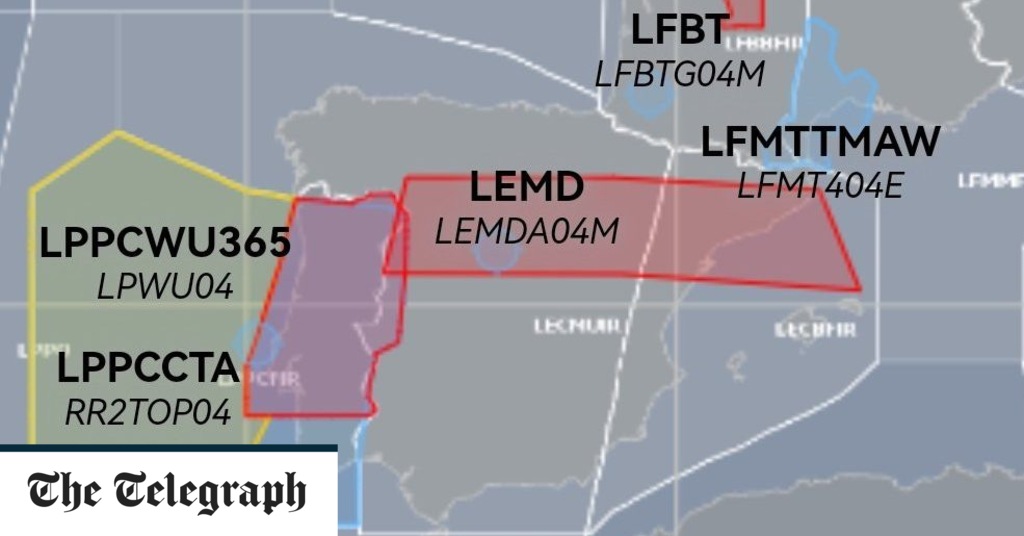

As a result of a Chinese missile falling out of control, Spain was forced to close its skies.
China’s most powerful rocket, the Long March 5B (CZ-5B), launched on October 31 from southern China. It was designed to deliver the last unit of the Chinese space station currently in construction.
Spain closed airspace above Catalonia’s northeastern Region and three other regions on Friday because the missile’s remnants are expected pass.
“Due the danger associated with space object CZ-5B’s passage through Spanish airspace, flights were restricted from 9.38 AM to 10.18 AM in Catalonia” said Catalan emergency officials on Friday.
The analysis by the aerospace company’s Center for Orbital and Return Debris Studiess (CORDS), revealed an expected return time at 5.56 p.m. GMT, with a six hour window of uncertainty on either end.
The rocket travels at an average speed of eight kilometers per second. Any deviation of just a few minutes can result in re-entry over a thousand kilometers.
It is expected that most of the rocket will be destroyed by gravity upon return to Earth. However, there are concerns about large portions of it.
The European Union’s Space Monitoring and Tracking Service warned that the debris could return to Earth’s atmosphere in mid-Atlantic and likely land on the sea. It also warned of the possibility that it could also reach southern Italy, Portugal, and Spain. The missile.
EUSST stated that there is a low statistical probability of land impacts in densely populated areas. “However these predictions come with uncertainty. A better estimate will only become possible near reentry.”
This was the fourth flight for the Long March 5B since May 2020’s first launch.
Shrapnel from missiles was launched at first, and it landed on Ivory Coast. It damaged several buildings, but no injuries were reported.
The second expedition’s wreckage was unharmed and landed in Indian Ocean. The remains of the third expedition landed in Sulu Sea in Philippines.
When asked by Zhao Lijian, a spokesperson for the Chinese Foreign Ministry, Zhao Lijian said that re-entering the atmosphere was a common international practice.
“It is understood that the type of missile you mentioned uses special technology designed so that the vast majority of components are destroyed by ablation during re-entry, and the potential for damage to flight and ground activities is very low,” Zhao said.
Source link
[Denial of responsibility! wideworldmag.co.uk is an automatic aggregator of the all world’s media. In each content, the hyperlink to the primary source is specified. All trademarks belong to their rightful owners, all materials to their authors. If you are the owner of the content and do not want us to publish your materials, please contact us by email – at wideworldmag.co.uk The content will be deleted within 24 hours.]
