

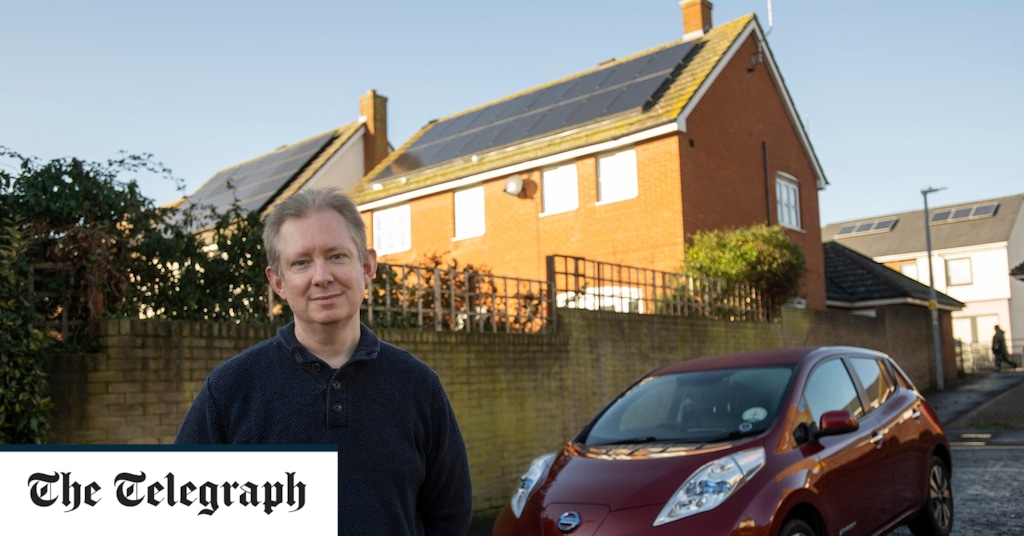

Adrian Bond invested in green and energy-efficient technology before he needed it – and before the government set its goal for “net zero” carbon emissions in 2050.
Homeowners will have to make expensive environmental upgrades and switch over to greener technology like electric cars as part of the drive to net zero. However, thousands of homeowners who leapt before they could be paid are now reaping their rewards as energy prices rise.
Bond didn’t have two heat pumps installed in 2007 in his detached Colchester home of four bedrooms.
They served as heat sources and air conditioners for the president, reducing his dependence upon gas for more than a decade prior to the conflict in Ukraine. Pushing wholesale energy prices to unprecedented levels.
Bond installed solar panels almost a decade ago. Since electricity prices are based on the cost of gas, Bond receives an exorbitant rate for power he exports into the national grid.
He is also among the hundreds of people who own shares of wind turbines in South Wales. This reduces electricity bills. Bond properties can generate so much profit they are now a tax liability.
It is not just about fitting homes with it, zero net investment is also possible heat pumpsAnd solar panels, or buying an electrical car.
A pilot scheme from Ripple Energy saw investors put in an average of £2,200 for wind turbines, which have already paid off £162 for each. According to the Association of Investment Firms (a trade organization), investors in renewable energy infrastructure funds have performed better than those who invested in global, British, or US equity markets.
Even though early birds may have caught the worms, there are still many opportunities for profit. Rightmove, the real-estate website, says that making a home greener can increase its value. Green features are more sought-after by first-time buyers, and agents are using them to their advantage.
Rightmove found a higher-level association in a study Energy Performance Certification Ratings The housing market is experiencing an increase in prices. EPC-rated homes are now the most popular type for finding a buyer.
Bond, a 49 year-old architect, said he knew early investments would pay off so he continued adding green features to the home. In 2014 he spent £8,000 on solar panels, which allows him to export power to the grid at 5p per kWh – even though he was paid eight times as much under old schemes.
Between what his supplier pays for the electricity the panels generate and the money saved by not using as much gas, Bond estimates he’s made £12,000 “and then some” since that initial investment.
Source link
[Denial of responsibility! wideworldmag.co.uk is an automatic aggregator of the all world’s media. In each content, the hyperlink to the primary source is specified. All trademarks belong to their rightful owners, all materials to their authors. If you are the owner of the content and do not want us to publish your materials, please contact us by email – at wideworldmag.co.uk The content will be deleted within 24 hours.]
