

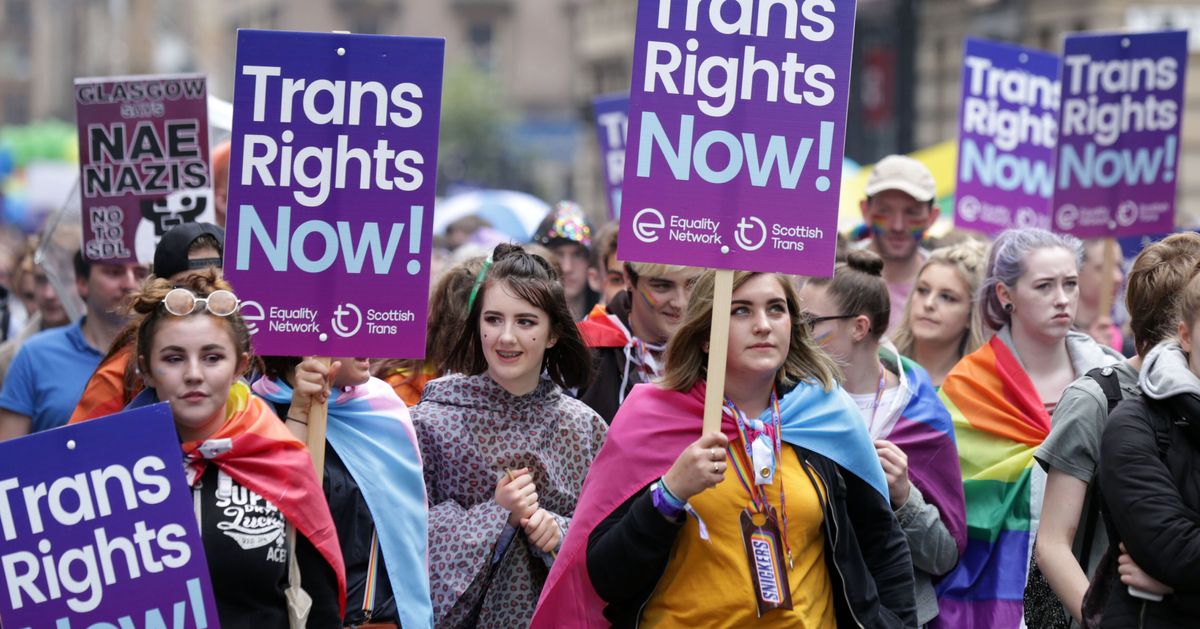
The UK government has been accused of placing trans people at the heart of a “crisis they did not ask for” by vetoing Scottish parliament legislationReforms to the gender recognition process
To prevent the occurrence of the infamous Scotland Act Section 35, the UK government used this section. Gender Recognition Reform Bill Assent was granted to the royals because the monarch believed it could have an adverse effect on legislation that is reserved for Westminster.
This was the first use of such powers since 1999, when the Scottish parliament was established. This exacerbated already simmering tensions between Downing Street (and Holyrood).
The bill was intended to make it easier to legally change your gender.
Labour’s Angela EagleConservative MP Elliot Colburn – the co-chairs of the all-party parliamentary group on global LGBT+ rights – have written to prime minister Risi Sunak to warn the UK government is “politicising the day to day lives of an already marginalised community”.
The MPs write: “This move, although one we appreciate has not been taken lightly, will bring with it significant ramifications of a social, legal and political nature. We are deeply concerned that the government’s course of action risks further politicising the very real struggles of the trans community and placing their identities and lives at the centre of a constitutional crisis.
“Trans people are amongst the most marginalised and stigmatised in the UK today and face significant barriers to equality across many areas of life. Hate crimes against trans people increased by 56% over the last year – the highest increase across any protected characteristic under hate crime law.
“They are twice as likely as non-trans LGBT+ people to undergo conversion practices and significantly more likely to take their own life.”
They also raised concerns about the UK’s review of countries whose process to change gender in legal documents is recognized by the UK. The MPs say they are “concerned about the uncertain position this places trans migrants living in the UK, and indeed the impact this decision may have on our bilateral and multilateral relationships”.
They go on: “The United Kingdom was once a global leader in LGBT+ rights, paving the way for the protection and advancement of LGBT+ communities … however, the course of action being taken by government will not only serve to further damage our reputation at an international level, but leave a legacy of broken trust with LGBT+ communities that may be increasingly difficult to rebuild.
“Crucially, we must remember that there are real people being impacted by these ongoing discussions at an inter-personal, parliamentary and national level: trans people across the UK who simply want to be their authentic selves free from abuse, harassment or stigmatisation. We hope you will meet with us in the coming weeks to discuss these issues as a matter of urgency.”
Scotland’s first minister, Nicola Sturgeon, branded the move a “full-frontal attack on our democratically-elected Scottish parliament and its ability to make its own decisions on devolved matters”.
The UK government was believed to be ready for lengthy legal wrangling at Westminster.
The legislation allows for transgender individuals in Scotland to be legally recognized in their preferred gender for the first time without the need for a medical diagnostic.
It would also reduce the time they must live in their acquired gender to apply for a GRC and reduce the age at application to 16.
Source link
[Denial of responsibility! wideworldmag.co.uk is an automatic aggregator of the all world’s media. In each content, the hyperlink to the primary source is specified. All trademarks belong to their rightful owners, all materials to their authors. If you are the owner of the content and do not want us to publish your materials, please contact us by email – at wideworldmag.co.uk The content will be deleted within 24 hours.]
