

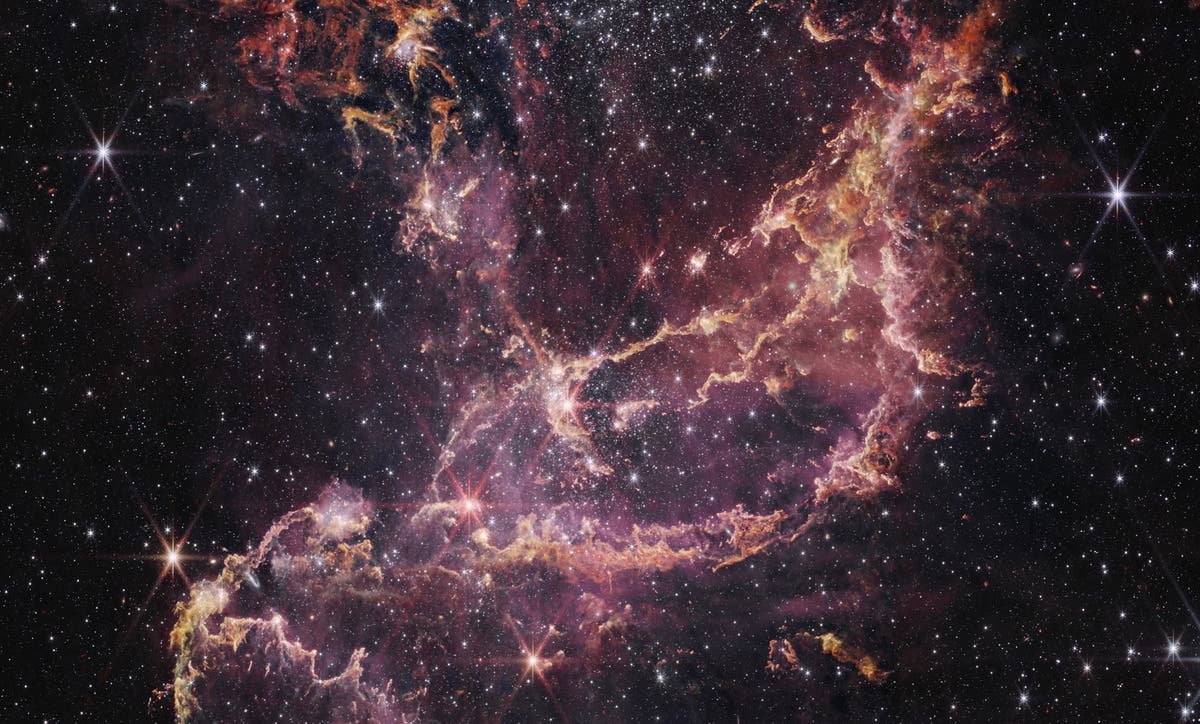
A new image from the James Webb Space Telescope may show the planets’ beginnings.
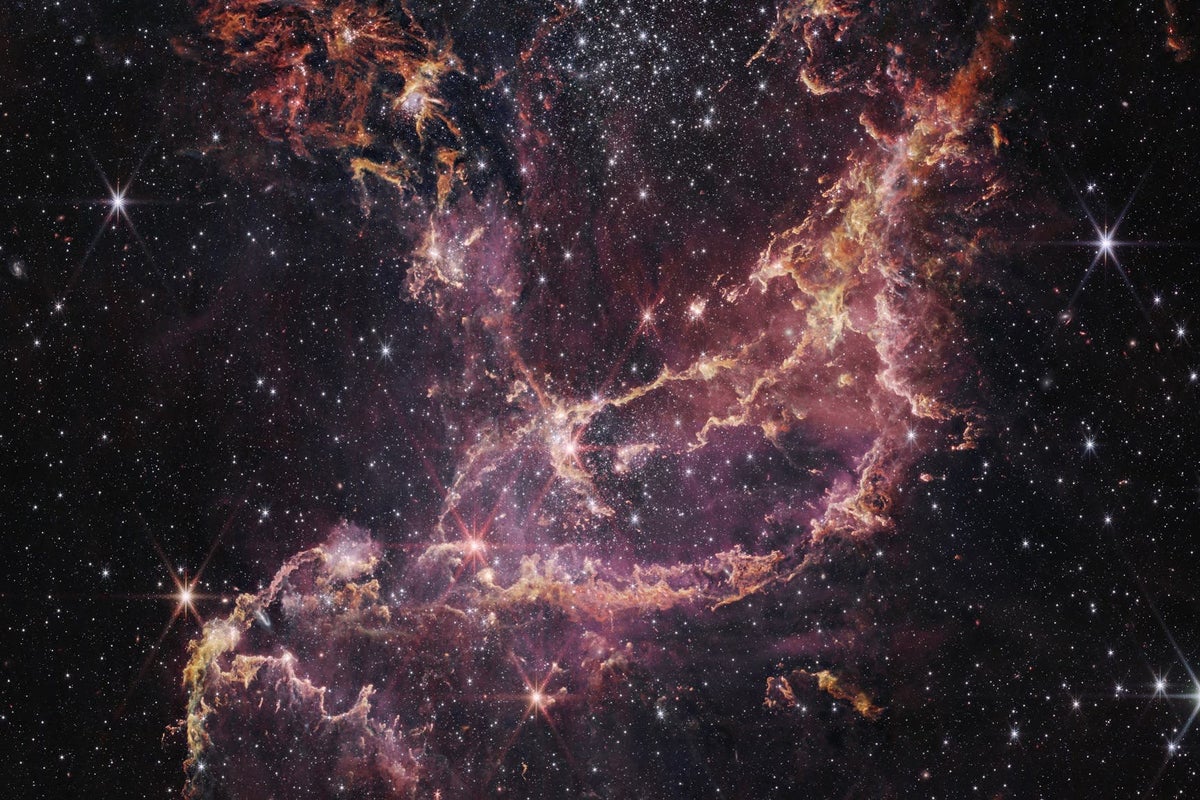
The new, wide, swirling image shows NGC 346, a small cluster consisting of stars located in the Small Magellanic Cloud or SMC. It can be found more than 200,000 light years from Earth.
Scientists believe that the conditions in this star cluster are very similar to those of the early universe, which was rapidly creating new stars.
Scientists can now see the process in action and observe stars form. It could also include planets which could mean that new worlds are forming earlier than scientists realized.
NGC 346 is shown in this NASA James Webb Space Telescope photo. It is a dynamic star-cluster located in a nebula that is approximately 200,000 light years away.
(Sciences: NASA, ESA, CSA, Olivia C. Jones (UK ATC), Guido De Marchi (ESTEC), Margaret Mixner (US) Image processing: Alyssa Pagan (STScI), Nolan Hubble (US), Laura Linkic (USA) Laurie Yu Chu (NASA Ames))
Astronomers believe that this region can be used to shed light on how the first stars formed in “cosmic noon”, which is two or three trillion years after the Big Bang.
The new image is now available Scientists announce that the first JWST planet has been found – and that it is remarkably similar to Earth.
Guido De Marchi from the European Space Agency, co-investigator of the research team that produced the image, stated: “We’re noticing the building blocks, both stars and potentially planets.
“Since the Small Magellanic Cloud is in a similar environment as galaxies during cosmic noon, it’s possible that rocky planets formed earlier than we thought.”
NGC 346 contains protostars, which are clouds in space of gas and particles that eventually develop into stars.
Astronomers believe studying protostars is the best method to understand how stars are formed.
Stars are formed when they capture gas and dust. They can appear like ribbons of molecular cloud.
The central protostar receives matter from a disk.
Astronomers had previously detected gas around NGC 346 protostars, but JWST observations also detected dust within these disks.
Olivia Jones, Webb fellow at STFC’s Science and Technology Facilities Council and lead author on the paper currently undergoing peer review, said that “This is the first-ever time we have been in a position to discover the entire sequence of star formation. in another galaxy.
“This means we have a lot more data to study at higher resolution, which gives us new information about the way stars form and how they interact with their environment. This also gives us insight into star formation.”
Additional coverage by The Press Association
Source link
[Denial of responsibility! wideworldmag.co.uk is an automatic aggregator of the all world’s media. In each content, the hyperlink to the primary source is specified. All trademarks belong to their rightful owners, all materials to their authors. If you are the owner of the content and do not want us to publish your materials, please contact us by email – at wideworldmag.co.uk The content will be deleted within 24 hours.]
